2021 WEBINAR
Held on May 7 AND 21 , 2021, as the opening session of the International Congress on Sexual Abuse and Deaf People, organized by the Deaf Catholic Youth Initiative for the Americas (DCYIA). This bilingual and multilingual event (English, Spanish, American Sign Language, and Mexican Sign Language) brought together Deaf leaders, clergy, survivors, and advocates from several countries to begin an international conversation about sexual abuse affecting Deaf individuals.
The opening session emphasized awareness, testimony, and community leadership
Archbishop Charles Scicluna of Malta delivered the welcome remarks, highlighting the importance of safeguarding and accountability within faith communities. Juan Carlos Cruz (Chile), a survivor and internationally recognized advocate, shared his personal journey and reflected on remaining engaged with the Catholic Church after experiencing abuse. A panel of Deaf leaders discussed how the DCYIA model promotes inclusion, leadership, and protection within Deaf Catholic communities.
the second session concentrated on the practical skills needed to respond effectively to sexual abuse within the Deaf community.
Speakers included Archbishop Patrick Kelly (United Kingdom), Sister Bonnie McMenamin, Dr. Leo Hidalgo (Miami, Florida), Rafael Treviño (Washington, DC), Maryann Barth (Kentucky, USA), Vivian Cardona (Chicago, USA), and Verónica Castillo (Chile). Their presentations addressed critical topics such as training sign language interpreters for abuse-related situations, psychosocial assessment and referral services for Deaf survivors, and cross-disciplinary collaboration among interpreters, mental health professionals, educators, and pastoral workers.

Together, the two webinars formed a comprehensive international initiative.
Part 1 focused on listening to survivors, strengthening Deaf leadership, and recognizing the realities of abuse, while Part 2 provided practical tools for prevention, intervention, referral, and long-term support. The series demonstrated that protecting Deaf children and adults from sexual abuse requires accessible communication, trained professionals, accountable institutions, and the active participation of the Deaf community itself.
2022 WEBINAR My Family, Our Family: Deaf People, the Church and Sexual Abuse
This event built upon the conversations and professional networks established during the 2021 and moved the discussion toward family support, community healing, and coordinated safeguarding responses.
the webinar featured keynote presentations by Fr. Hans Zollner, S.J., an internationally recognized expert in safeguarding and abuse prevention within the Catholic Church, and Fr. Joe Mulcrone, who has extensive experience in Deaf ministry and pastoral care.
Their presentations explored how families, churches, and institutions can respond more effectively to the realities of sexual abuse affecting Deaf children and adults. Their participation suggests that the webinar combines theological, pastoral, ethical, and safeguarding perspectives.
A central component of the webinar was its four breakout sessions, which were designed for different stakeholder groups:
Members of the Deaf community, pastoral workers and clergy, mental health professionals and educators, and sign language interpreters. This structure encouraged participants to discuss challenges specific to their roles while developing practical strategies for prevention, reporting, accompaniment, and long-term healing.
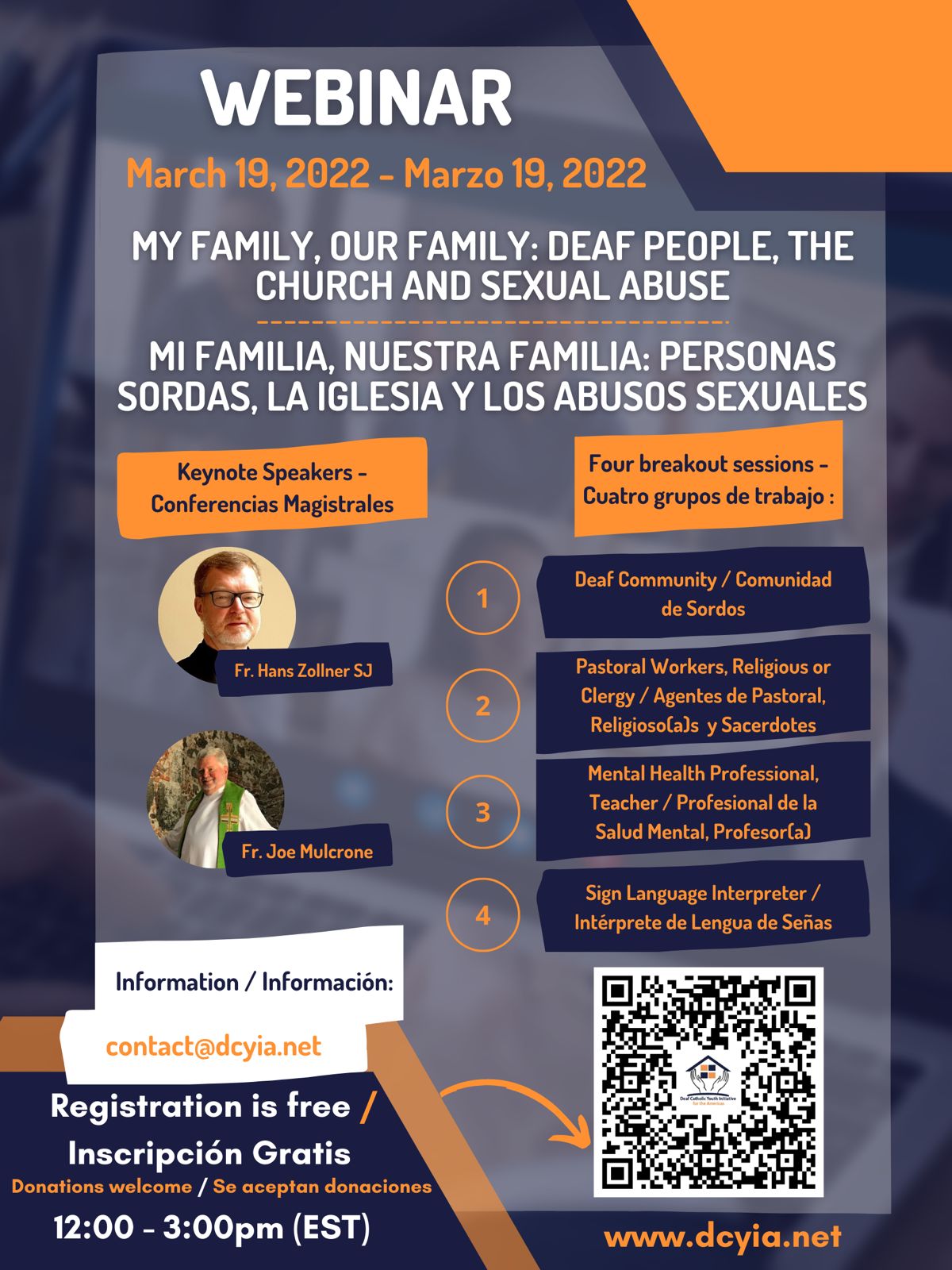
A central component of the webinar was its four breakout sessions, which were designed for different stakeholder groups:
Members of the Deaf community, pastoral workers and clergy, mental health professionals and educators, and sign language interpreters. This structure encouraged participants to discuss challenges specific to their roles while developing practical strategies for prevention, reporting, accompaniment, and long-term healing.
The 2022 webinar represented an important evolution of the 2021 initiative.
While the First webinar emphasized recognizing abuse, listening to Deaf survivors, and training professionals, My Family, Our Family focused on strengthening support systems around Deaf individuals, promoting collaboration among families and professionals, and fostering safer, more inclusive faith and community environments. The event highlighted that protecting Deaf people from sexual abuse requires not only institutional policies but also accessible communication, informed families, culturally competent services, and the active leadership of Deaf people themselves.
This structure acknowledges that preventing and responding to abuse requires collaboration among Deaf individuals, families, educators, therapists, interpreters, and religious leaders.
2026: Prevention and Response to Abuse in Deaf People with Neurodevelopmental Disorders and Older Adults
The third webinar in the safeguarding series was held on June 8, 2026, as a collaboration between CeproMe Latinoamérica and the Deaf Catholic Youth Initiative for the Americas (DCYIA).
Titled "La prevención y atención del abuso en personas sordas, con trastornos del neurodesarrollo y adultos mayores" (Prevention and Response to Abuse in Deaf People with Neurodevelopmental Disorders and Older Adults)
The webinar marked a significant expansion of the initiative by focusing on Deaf individuals who face multiple and intersecting vulnerabilities.the webinar marked a significant expansion of the initiative by focusing on Deaf individuals who face multiple and intersecting vulnerabilities.
The webinar featured presentations by Maryann Barth and Laureen Lynch Ryan of DCYIA, Dr. Valeria Sordo of the Archdiocese of Santa Fe, Argentina, and Dr. Patricia Espinosa of CeproMe Latinoamérica.
Together, the speakers examined how abuse affects Deaf people across different stages of life and disability contexts, with particular attention to children and adults with neurodevelopmental disorders, as well as Deaf older adults, who are often overlooked in safeguarding policies and support services.

Unlike the earlier webinars, which focused on survivor testimony, church accountability, family support, and general professional training
This session concentrated on prevention, early identification, intervention, and coordinated care for Deaf people with additional support needs. The presenters emphasized the importance of accessible communication, multidisciplinary collaboration, trauma-informed services, caregiver education, and specialized safeguarding strategies for populations that may experience increased dependence on others, social isolation, or barriers to reporting abuse.

The webinar also highlighted the need for stronger partnerships
Among mental health professionals, educators, social workers, interpreters, pastoral workers, caregivers, and Deaf advocates, recognizing that effective protection requires a coordinated network of services rather than isolated interventions.
As the third webinar in the series, this event represents the progression of the DCYIA and CeproMe safeguarding initiative from raising awareness (2021), to strengthening family and community responses (2022), and finally to developing specialized prevention and protection strategies for Deaf people with complex vulnerabilities (2026). It underscores the central message that safeguarding must be inclusive, accessible, and responsive to the diverse needs of Deaf individuals throughout the lifespan.